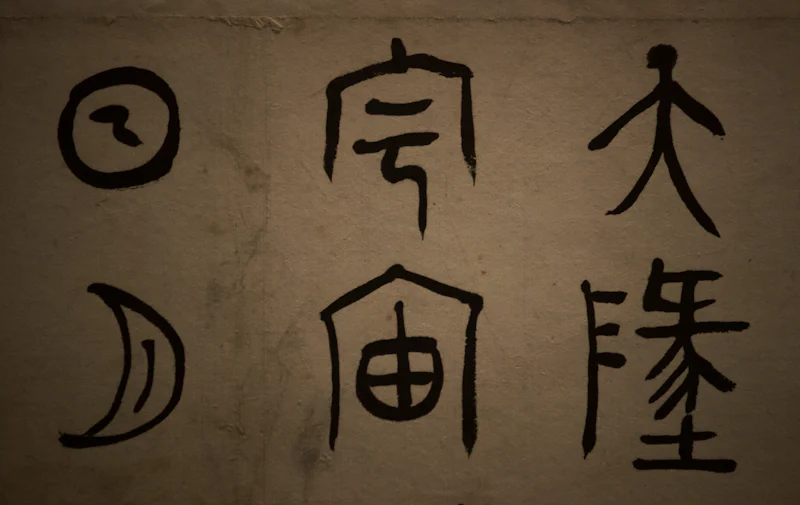
A common misconception is that Chinese characters are simply "pictures" of the things they represent. While the script’s origins are indeed rooted in drawings, modern Chinese writing is far more complex than a collection of simple pictographs.
The Origins: True Pictographs
In its earliest form—found on oracle bones from over 3,000 years ago—Chinese characters were highly pictographic. Ancient scribes drew simplified sketches of physical objects. Some of these remain recognizable in their modern forms:
- 山 (shān): Originally drawn with three peaks to represent a "mountain."
- 木 (mù): A vertical line with branches representing a "tree."
- 日 (rì): A circle with a dot in the center representing the "sun."
- 月 (yuè): A crescent shape representing the "moon."
Today, however, these "true pictographs" make up only about 4% of the most commonly used characters.
The Modern System: Phono-semantic Compounds
The vast majority of modern Chinese characters—over 90%—are what linguists call phono-semantic compounds. These characters are composed of two distinct parts:
- The Semantic Element (Meaning): A "radical" that gives a hint about the general category of the word (e.g., the "water" radical 氵 appearing in words related to liquid).
- The Phonetic Element (Sound): A component that provides a clue to the character's pronunciation.
For example, the character 妈 (mā) meaning "mother" uses the 女 (nǚ) radical for "woman" (the meaning) and the character 马 (mǎ) for "horse" (the sound).
Abstract Ideographs
Chinese also utilizes ideographs to represent abstract concepts that cannot be easily drawn.
- Direct Ideographs: Simple symbols like 一 (one), 二 (two), and 三 (three), or 上 (up) and 下 (down).
- Logical Aggregates: Characters that combine two meanings to create a new one. For instance, combining the character for "sun" (日) and "moon" (月) creates 明 (míng), which means "bright."
Why It Matters for Learners
Understanding that Chinese is logographic (symbols representing words or morphemes) rather than purely pictographic is a breakthrough for many students. Instead of trying to find a picture in every character, learners focus on identifying the "building blocks" (radicals and phonetic components) which make memorization much more logical and efficient.
#ChineseWriting #Hanzi #LanguageLearning #ChineseCulture #Etymology
