Chinese opera masks, or lianpu (脸谱), primarily represent the character traits, morality, and social status of figures from traditional Chinese folklore. When found on Chinese traditional tools—such as hand-painted storage boxes, artisan inkstones, or decorative fans—these masks serve as visual shorthand for specific personality archetypes. Understanding these symbols is essential for expats who want to decode the historical meaning behind the cultural artifacts they collect during their travels. By learning to identify the dominant colors and facial patterns, you can determine if a depicted character represents a loyal general, a treacherous official, or a cunning spirit.
Decoding the Language of Colors
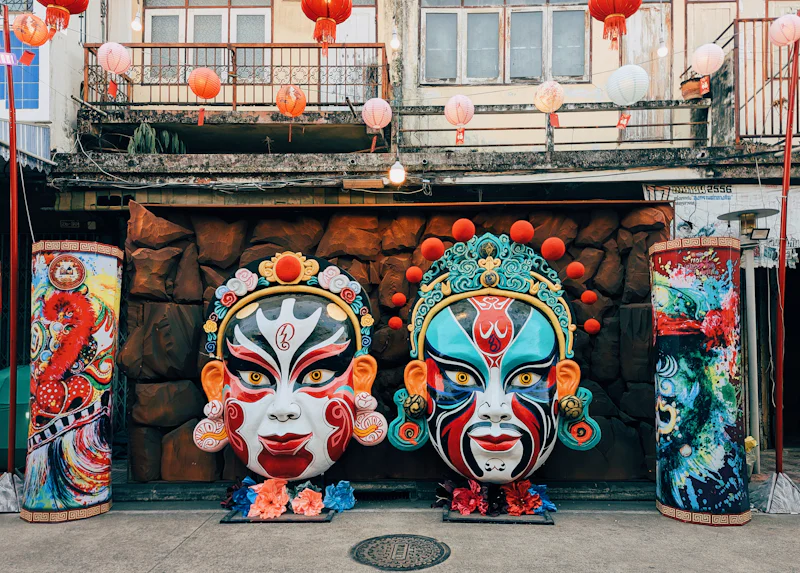
The most straightforward way to interpret lianpu is through color symbolism. Each hue acts as a diagnostic tool to tell you exactly who is being portrayed. For instance, a red mask signifies loyalty, bravery, and integrity—common for heroic figures like Guan Yu (关羽). Conversely, a white mask often represents craftiness, suspicion, or hidden malice, frequently used for villains. Black is typically reserved for characters who are upright and neutral, while gold or silver masks are almost exclusively used for deities or supernatural beings. If you purchase an item with a green mask, you are likely looking at an impulsive or stubborn, yet courageous, character.
Identifying Specific Facial Patterns
The structure of the paint application provides further depth beyond basic color. Traditional tools often feature the zheng lian (整脸) or 'whole face' pattern, which indicates a character with a simple, balanced nature. More complex designs, like the sankuai wa (三块瓦) or 'three-tile' face, feature distinct patches of color that suggest a complex personality, often seen on warriors. If you are examining a wooden tool or a decorative plate, look at the eyebrows and forehead. A stylized 'fire' pattern often denotes a volatile temper, while a crescent moon shape might imply that the character has a connection to the spirit world or possesses supernatural wisdom.
Interpreting Context on Traditional Tools
When these masks appear on functional items, they are rarely purely decorative; they are often meant to bestow the characteristics of that mask onto the owner. For example, a calligraphy brush rest decorated with a red opera mask is designed to inspire the 'loyalty' and 'discipline' necessary for the arts. If you find kitchen or household tools featuring the mask of a jovial, rounded-face character, they are intended to invite luck and prosperity into the home. Be wary of mass-produced items where mask features are blurred or misapplied, as authentic artisan pieces—particularly those produced in regions like Sichuan (四川), famous for its bianlian (变脸) or 'face-changing' opera—will have crisp, deliberate lines and clear color boundaries that follow the strict rules of Jingju (京剧) or Beijing Opera aesthetics.
Navigating Markets and Authenticity
Expats often encounter these masks in antique markets or souvenir shops. A common pitfall is assuming that all colorful masks represent good luck. Some masks signify malevolent spirits that were meant to be 'frightened away' from the home, so they are not necessarily protective symbols in the traditional sense. When evaluating a piece, look for the 'brush stroke'—mass-produced items will have pixelated edges or perfectly symmetrical printed patterns. A genuine piece will show slight variations in the paint density, indicating that the artist followed traditional guidelines to create a specific, meaningful character.
Mastering the symbolic language of opera masks allows you to transform a simple souvenir into a meaningful piece of history that tells a distinct story. What is the most intriguing cultural artifact you have discovered in a local market, and have you been able to decipher the story behind its design?
