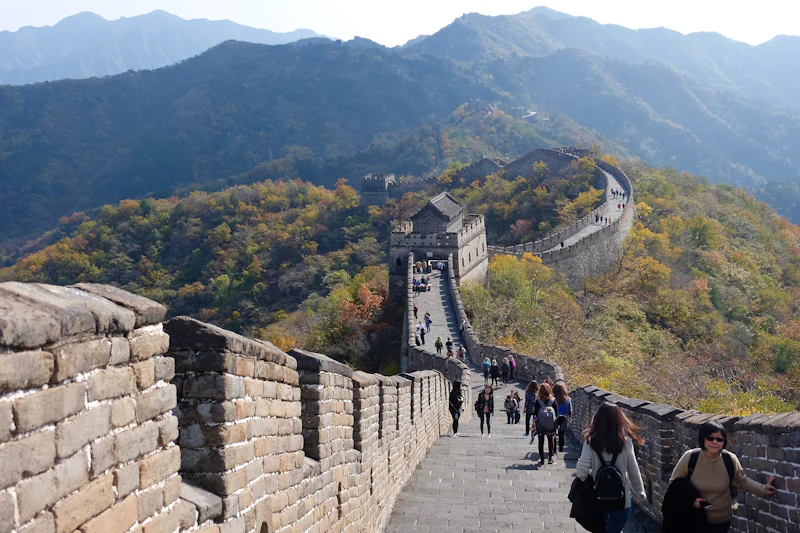
When standing on the battlements at Badaling or Mutianyu, two of the most frequent questions from international visitors are simple yet profound: Just how long is this structure, and why exactly was such an immense project undertaken?
Based on the official UNESCO World Heritage description, here are the facts behind the legend.
The Scale: More Than Just a Wall
The length of the Great Wall is staggering. It is not a single, unbroken line but a complex network that includes walls, horse tracks, watchtowers, and fortresses.
- Total Length: The complete route stretches for more than 20,000 kilometers (approx. 12,427 miles).
- The Route: It spans the breadth of northern China, beginning in the east at the ocean-facing Shanhaiguan in Hebei province and ending at the desert outpost of Jiayuguan in Gansu province to the west.
- Composition: It serves as a “meandering landscape feature,” integrating perfectly with the topography of mountains and plains.
The Purpose: Defense and Culture
The construction of the Great Wall was driven by a singular strategic purpose that spanned over 2,000 years, from the 3rd century B.C. to the 17th century A.D.
- Military Defense: Its primary function was to serve as a united defense system against invasions from nomadic civilizations to the north. It stands as physical evidence of the “mighty military and national defence forces” of ancient central empires.
- Cultural Preservation: Beyond stopping armies, the Wall was designed to preserve the culture of China’s agricultural society from the customs of “foreign barbarians.”
- Security: It embodied the national symbol for safeguarding the security of the country and its people, regulating the collision and exchange between different civilizations.
From the early fortifications joined under Qin Shi Huang (c. 220 B.C.) to the masonry masterpieces of the Ming Dynasty, the Great Wall remains an enduring symbol of resilience and strategic thinking.
Links
Official website page (in Chinese only)
Great Wall of China (TravelChinaGuide.com)
