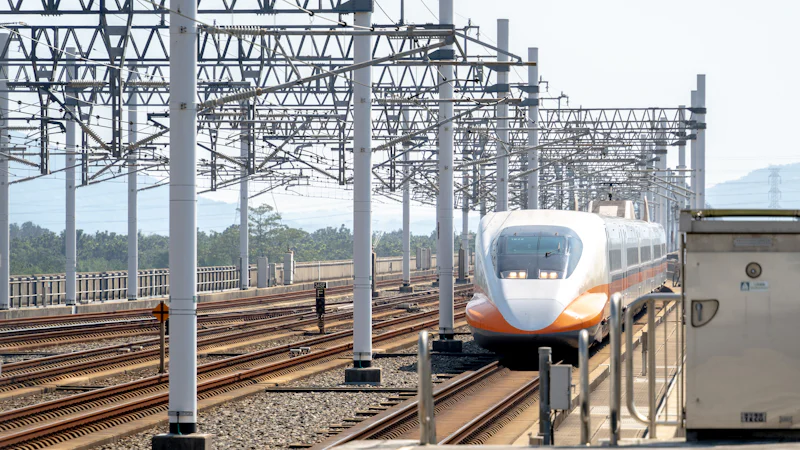
While most travelers are still asleep in the pre-dawn hours of the morning, a special kind of train departs from Guangzhou South Station. It carries no passengers, sells no tickets, and follows a strict schedule that concludes before the first commuter even reaches the platform. This is the “Doctor Train,” and for veterans like Wen Zhanjing, it is the front line of railway safety.
As the Spring Festival travel rush of 2026 reaches its final stages, the Guangzhou-Shenzhen-Hong Kong High-Speed Railway remains one of the busiest corridors in the world. To ensure that the thousands of passengers traveling between these major hubs reach their destinations safely, Wen and his team perform a daily “physical examination” of the entire line.
The Man Behind the Mission
Wen Zhanjing is a foreman at the Guangzhou South HSR Maintenance Section. At nearly 60 years old, this year’s Spring Festival rush marks the final one of his career. Despite his impending retirement, his routine remains as disciplined as a soldier’s. His internal clock wakes him at 3:20 AM, well before his alarm sounds, allowing him to arrive at the station by 4:00 AM to begin equipment calibration.
“During the return travel peak, we have to be on-site early,” Wen explains. His task is to monitor a sophisticated array of sensors that check the tracks, overhead power lines, and communication signals for the slightest irregularity.
Precision at 300 Kilometers Per Hour
The inspection train, known in Chinese as the Dongjianche, is a modified high-speed rail set equipped with high-precision diagnostic tools. As the train glides out of Guangzhou South at 4:59 AM, Wen’s eyes never leave the data monitors.
The 102-kilometer journey to Shenzhen North involves navigating complex tunnels—including the massive Shiziyang Tunnel—and numerous turnout sections where tracks diverge. These are high-wear areas that require meticulous observation. “Every extra bit of care we take is an extra bit of peace of mind for the passengers,” Wen says, his voice steady over the hum of the train.
A Legacy of Safety
Throughout his career, Wen has distilled decades of frontline experience into what his colleagues call the “Wen Zhanjing Inspection Method,” a set of practical protocols he now passes on to the younger generation of railway engineers. Even in his final weeks on the job, he continues to record every data point by hand in a meticulously kept logbook, ensuring that the standard of excellence he helped build remains intact after he hangs up his uniform.
By the time the sun rises over Shenzhen North Station and the first passenger trains begin to board, Wen’s work is done. The tracks have been cleared, the systems verified, and the way made safe for millions. It is the invisible labor of dedicated professionals like Wen that maintains the world-class reputation of China’s high-speed rail network.
#ChinaRailways #HighSpeedRail #SpringFestival2026 #Infrastructure #TravelSafety
