Your trip qualifies for China’s 144-hour visa-free transit only if you are flying from Country A, entering a specific city in China (B), and then departing directly to a third Country C. This “A → B → C” route is the most critical and non-negotiable part of the Transit Without Visa (TWOV) policy. A simple round trip from your home country to China and back will not work. Your entire itinerary, including all flight segments, must clearly show this three-country progression to be eligible.
The ‘Third Country’ Rule Explained

This is the concept that causes the most confusion. The key is that your origin and final destination cannot be the same country. This rule also applies to territories. For example, traveling from New York (USA) to Shanghai and then onward to Guam is not a valid transit because Guam is a U.S. territory. However, Hong Kong and Macau are considered separate regions for this policy, making them valid third destinations.
- Valid Itinerary: Los Angeles (USA) → Beijing (China) → Tokyo (Japan). This is a perfect A → B → C route.
- Valid Itinerary: London (UK) → Shanghai (China) → Hong Kong. Hong Kong works as the third region.
- Invalid Itinerary: Sydney (Australia) → Guangzhou (China) → Sydney (Australia). This is a round trip and does not qualify.
- Invalid Itinerary: Vancouver (Canada) → Shanghai (China) → Beijing (China) → Toronto (Canada). Any itinerary with multiple stops within mainland China that doesn't continue to a third country is invalid. Your ticket must show you are leaving mainland China for the third destination.
Eligible Nationalities and Ports of Entry
To use the 144-hour TWOV, you must hold a passport from one of the 54 eligible countries. This list includes the United States, Canada, the United Kingdom, Australia, New Zealand, all Schengen Area countries, Japan, South Korea, and Singapore, among others. Always check the latest official list before booking, as policies can change.
This policy is also only available at specific ports of entry. Major hubs include Beijing (PEK & PKX), Shanghai (PVG & SHA), Guangzhou (CAN), Chengdu (TFU), Chongqing (CKG), and Shenzhen (SZX). Crucially, you are generally restricted to the administrative region of your arrival. For example, if you enter via Shanghai, you can travel within Shanghai, Jiangsu, and Zhejiang provinces, but you cannot take a flight or train to Beijing. The clock on the 144 hours officially begins at 00:01 on the day following your arrival, giving you a bit of extra time on your arrival day.
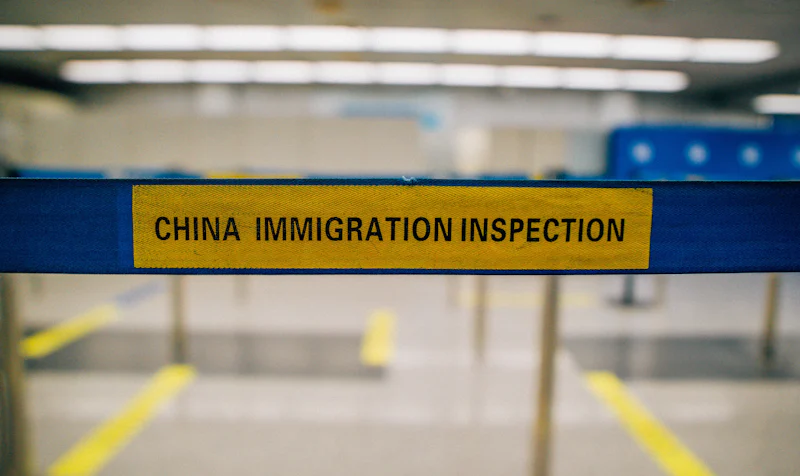
Required Documents and the On-Arrival Process
When you land in China, do not follow the main queues for foreign passport holders. Instead, look for the dedicated counter for 144-hour Transit Visa Exemption. Airlines should provide you with an Arrival/Departure Card on the flight; fill this out completely. At the counter, you must present:
- Your valid passport with at least three months of remaining validity.
- Your confirmed onward flight ticket to a third country or region, with a departure time within 144 hours of your arrival.
- The completed Arrival/Departure Card.
An immigration officer will review your documents, confirm your eligibility, and place a temporary entry permit sticker in your passport. It helps to have a printed copy of your onward flight confirmation, as airport Wi-Fi can be unreliable. Knowing the Chinese phrase for the service, 144小时过境免签 (144 xiǎoshí guòjìng miǎnqiān), can also be useful if you need to ask for directions.
Common Pitfalls and How to Avoid Them
Many travelers are rejected not at Chinese immigration, but by their airline's check-in staff at their point of origin. Some airline employees are not fully trained on the specifics of the TWOV policy. To avoid this, have a printed copy of your onward flight confirmation ready and be prepared to calmly explain the A → B → C rule. Having a screenshot of the official regulation from an embassy website can also help.
Another common mistake is booking separate tickets that don’t clearly show a transit itinerary. While technically allowed, it can make it much harder to convince airline staff. A single booking reference that shows your full A → B → C journey is the safest option. Finally, remember that your mode of transport matters. You must arrive and depart by air from one of the designated airports (though some cities like Shanghai also include sea and rail ports).
Ultimately, the success of your transit hinges on the simple, unbending logic of the A → B → C country rule.
For those who have used it, which airline or departure airport was the smoothest (or most difficult) when checking in for your flight to China?
Quick Takeaways:
- You must travel from Country A, through China, to a different Country C.
- Your passport must be from one of the 54 specified eligible countries.
- Carry a printed copy of your onward ticket departing within 144 hours.
- You are only permitted to stay within the specific administrative region of your arrival city.
#chinatransit #visafree #144hourvisa
