Telling real Chinese jade, or 玉 (yù), from a fake often comes down to two simple physical tests: hardness and sound. Real jade is incredibly hard and dense. You can perform a scratch test by gently trying to scratch the stone with a steel knife or pin; genuine jade won't show a mark. Second, the sound test involves lightly tapping the jade with another piece of jade or a metal coin. Real jade produces a high-pitched, resonant, bell-like chime, whereas fakes like serpentine or glass will produce a dull, flat thud.
Simple Tests to Spot Fake Jade
While the scratch and sound tests are good starting points, a few more observations can help. Real jade feels cool and smooth to the touch and takes a while to warm up in your hand. Fakes made of plastic or glass will warm up much faster. Look closely at the material under a light. If you see tiny air bubbles, you are almost certainly looking at glass. For the scratch test, be precise. Both major types of jade—nephrite and jadeite—are hard. Nephrite has a Mohs hardness of 6.0–6.5, and jadeite is 6.5–7.0. A steel knife blade is only about 5.5, so it shouldn't scratch either. However, be aware that some high-quality fakes made of quartz (hardness 7) can pass this test, which is why a single test is never enough.
What Determines Real Jade's Value
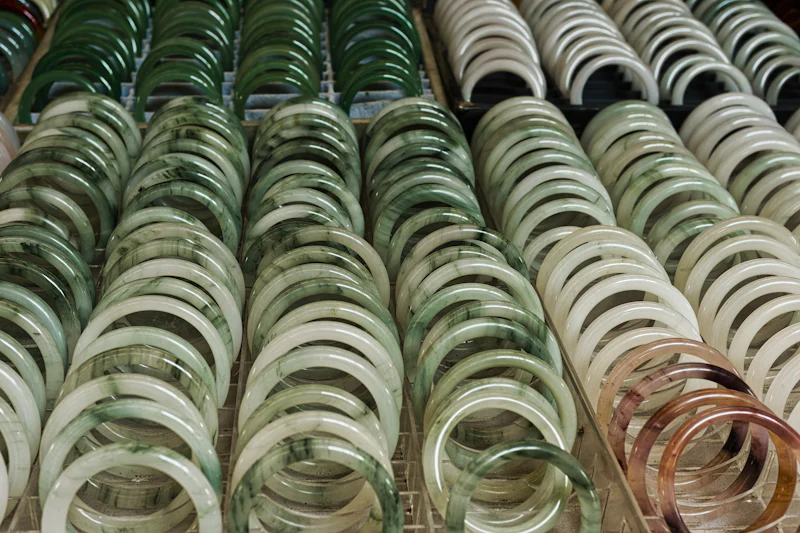
The value of Chinese jade is not a simple calculation. It depends on a combination of factors, starting with its type. Jadeite (硬玉 yìngyù, or ‘hard jade’) is rarer and generally more valuable than nephrite (软玉 ruǎnyù, or ‘soft jade’), which is the more traditional stone historically used in China. Beyond type, these four characteristics are critical:
- Color: The most important factor. For jadeite, a vivid, deep “Imperial Green” is the most prized color in the world. Other valuable colors include lavender, red, and pure white (“mutton fat” nephrite). The evenness and intensity of the color are paramount.
- Translucency: This refers to how much light can pass through the stone. Higher translucency, which gives the jade a watery or glowing appearance, dramatically increases its value.
- Texture: A fine, smooth, and consistent texture is ideal. Coarse or grainy textures with visible crystal structures are less desirable.
- Clarity: Like diamonds, jade is judged on its flaws. The fewer internal fractures, cloudy patches, or mineral inclusions, the higher the price.
Finally, the craftsmanship of the carving can add immense value, turning a good stone into a priceless piece of art.
Finding a Reputable Appraiser in China
For any piece of significant value, simple home tests are insufficient. You need a professional appraisal. Avoid appraisers recommended by the seller, as this is a clear conflict of interest. Instead, seek out an independent, certified gemologist or a government-accredited institution. The most respected authority in the country is the 国家珠宝玉石质量监督检验中心 (Guójiā Zhūbǎo Yùshí Zhìliàng Jiāndū Jiǎnyàn Zhōngxīn), or the National Gemstone Testing Center (NGTC). They have offices in major cities like Beijing and Shanghai and provide official certificates detailing a stone's properties and authenticity. This certificate is the gold standard for verifying Chinese jade value and is essential for any serious investment or resale.
Ultimately, identifying and valuing jade is a skill that combines scientific knowledge with an appreciation for artistry and history. What’s the most beautiful or interesting piece of jade you've seen in China, and did you learn anything new about it?
Quick Takeaways:
- Real jade has a hardness over 6.0 and should not be scratched by a steel knife.
- A high-pitched chime when tapped often indicates genuine, high-density jade.
- Value is determined by type (jadeite vs. nephrite), color, translucency, and clarity.
- For valuable items, get a certificate from a neutral appraiser like the NGTC.
#chineseculture #jade #antiques
